Guava Cold Hardiness: Varieties, Zones, and Tactics
As winter edges closer, many backyard orchardists are asking the same question: how far can guava go when temperatures tumble? Understanding guava cold hardiness is the difference between a thriving tropical-looking canopy in spring and a bundle of brown sticks after a hard freeze.
This guide brings clarity to a topic with plenty of conflicting anecdotes. We’ll compare species and varieties, translate temperature thresholds into plain-English decisions, and share a practical protection playbook for the chilly nights ahead. Whether you garden in a marginal Zone 8b pocket or a balmy Zone 10a, you’ll walk away with a plan to protect your guavas—and your harvests.
Plants don’t read zone maps, but they do respond to microclimates, timing, and preparation. Get those right, and you tilt the odds in your favor.
Why Guava Cold Hardiness Matters Now
Late fall and winter bring two kinds of cold events that challenge guava: clear, calm nights with radiational frost and windy, deep cold from advective freezes. Both can damage leaves and young wood on tender tropicals. Guava cold hardiness varies significantly by species and even within species, so choosing the right plant—and managing it well—pays dividends for years.
- Radiational frost usually nips leaves first, especially on exposed, outer canopy growth.
- Advective freezes drive cold air through the canopy, pulling heat away quickly and stressing wood and cambium.
For growers pushing the envelope in Zones 8–10, a small investment in the right variety and winter prep can mean full recovery and fruiting next season instead of starting over from the roots.
Species Spotlight: Psidium guajava vs. Hardier Cousins
Guava isn’t just one plant. Within the Psidium genus, species differ in their tolerance to cold and their response after a freeze.
Psidium guajava (Common Guava)
- The most widely grown for large, fragrant fruit.
- Sensitive to freezing temperatures; young leaves and tender twigs burn first.
- Expect defoliation when temperatures dip into the upper 20s°F; wood damage becomes likely with mid-20s°F and below, especially on unacclimated trees.
- Recovers well from defoliation if roots and main scaffold branches are healthy.
Psidium cattleianum / P. cattleyanum (Strawberry/Lemon Guava)
- Often marketed as strawberry guava (red fruit) and lemon or yellow strawberry guava (yellow fruit).
- Generally more cold tolerant than common guava. Established plants often handle mid-20s°F with manageable damage and can survive lower spikes with protection.
- Denser foliage and a shrubbier habit can make protection easier.
Psidium guineense (Brazilian/Guinea Guava)
- Reports and grower observations routinely place this species as more cold hardy than P. guajava.
- Fruit is smaller but aromatic; plants tend to be tough and resilient in marginal zones.
- A smart choice where winters flirt with freezing multiple times per season.
The big takeaway: if you regularly see 26–29°F, P. cattleianum and P. guineense offer a wider safety margin than P. guajava, and they bounce back faster in spring.
Cold Hardy Varieties, Thresholds, and Zones
Cold numbers aren’t absolutes—they depend on acclimation, duration, humidity, wind, plant age, and health. Use the ranges below as practical guardrails.
Practical Temperature Ranges (Established, Acclimated Trees)
- P. guajava (common guava):
- P. cattleianum/cattleyanum (strawberry/lemon):
- P. guineense:
Zone-by-Zone Guidance
- Zone 10a–10b: Grow any guava, but protect newly planted trees in year one. Late radiational frosts can still singe tender flushes.
- Zone 9a–9b: Favor strawberry/lemon guava and P. guineense for less drama. If growing P. guajava, site carefully and have covers ready.
- Zone 8b (warm microclimates): Strawberry/lemon guava and P. guineense are your best bets with strategic microclimate design. P. guajava can be grown as a dieback shrub with vigorous spring recovery, but expect heavier protection.
Cultivar Notes
Within P. guajava, cultivars vary slightly in tolerance, but differences are often overshadowed by microclimate and management. Seedling variability is real: seedlings from cooler-origin stock may show incremental hardiness. Prioritize plant health—well-fed, well-hydrated (but not waterlogged) trees tolerate cold better than stressed ones.
Microclimates, Site Design, and Protective Infrastructure
Cold protection starts with where and how you plant.
Microclimate Builders
- South-facing walls: Store daytime heat and release it at night. Plant 3–6 feet away to balance warmth with airflow.
- Thermal mass: Dark stone, brick, or water barrels near the trunk buffer temperature swings.
- Windbreaks: Fences or hedges reduce advective chilling. Keep windbreaks porous (about 50%) for best performance.
- Cold-air drainage: Avoid low pockets where cold pools. Slight slopes or raised beds help.
Soil and Nutrition Setup
- Moist (not saturated) soil holds more heat than dry soil. Water the day before a freeze if conditions are dry.
- Mulch smartly: 2–4 inches of coarse mulch moderates root temperatures. Pull mulch a few inches back from the trunk to prevent rot.
- Balanced nutrition: Avoid heavy nitrogen late fall, which encourages soft growth. Favor potassium and micronutrients for sturdier tissue.
Permanent or Semi-Permanent Structures
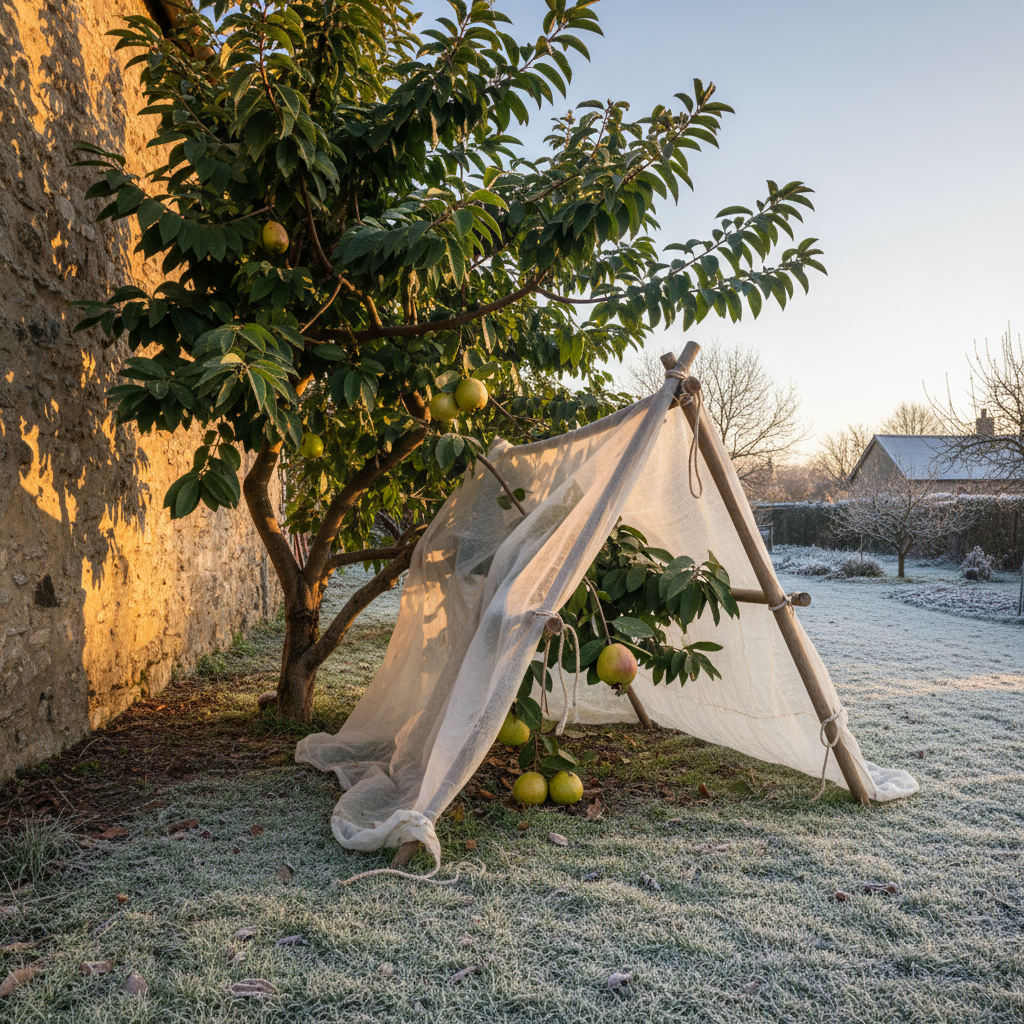
- Simple hoop or stake frames over each tree let you deploy frost cloth in minutes.
- Removable covers sized to the frame protect foliage without crushing it. Keep covers off leaves to prevent freeze-burn where fabric touches tissue.
Your Winter Protection Playbook
When forecasts turn frosty, act with purpose. Here’s a step-by-step plan you can reuse all winter.
1) 72–48 Hours Before a Cold Event
- Inspect trees for new, soft flush—these are most vulnerable.
- Pre-irrigate if the soil is dry to increase heat capacity.
- Stage materials: frost cloth, clothespins/clips, stakes/hoops, trunk wrap, C9 incandescent string lights or specialized tree-wrap heaters.
2) 24 Hours Before
- Build the frame and dry-fit your cover. Ensure it reaches the ground to trap radiant heat.
- Add thermal mass (water-filled containers) under the cover for overnight buffering.
- Wrap the trunk of young trees with breathable insulating material.
3) The Evening Of
- Drape frost cloth (not plastic) over the frame and secure to the ground. A 1–2 oz/yd² fabric typically adds 4–6°F of protection; doubling layers with a small air gap can add more.
- Turn on low-watt heat sources (C9 bulbs evenly spaced within the canopy). Avoid direct leaf contact with bulbs.
- If using plastic as a rain layer, keep it above the frost cloth and never touching foliage.
4) The Morning After
- As temperatures rise above freezing, vent or remove covers to prevent overheating and mildew.
- Reapply covers the next evening if a multi-night event continues.
5) After a Freeze: Recovery Protocol
- Do not rush to prune. Wait until new growth begins in late winter/early spring to see what wood is alive.
- Remove obviously mushy, blackened tips if they threaten disease spread, but delay structural cuts.
- Resume balanced feeding as soil warms; a light kelp or seaweed drench can support recovery (use judiciously, not as a “freeze cure”).
Special Situations
- Young trees (Year 1–2): Prioritize protection; even brief dips below 30°F can set them back.
- Container plants: Move under eaves, into garages, or against warm walls. Containers lose heat quickly; double up protection.
- Advective freezes (windy): Use additional wind shields and ensure covers are well anchored; heat loss is faster in wind.
Putting It All Together for 2025–2026
Here’s a simple framework to make guava cold hardiness work for you this season.
- Choose species by risk: P. cattleianum or P. guineense for regular mid-20s°F nights; P. guajava where freezes are rare and brief.
- Build a permanent frame now so protection is fast and repeatable.
- Keep a “freeze bin” stocked with cloth, clips, lights, and trunk wrap.
- Water, cover, and uncover on a schedule; consistency beats improvisation at midnight.
- After cold snaps, be patient. Guava often rebounds dramatically once soils warm.
With the right species and a reliable plan, your guava can look remarkably fresh in spring—even after a winter that tests your garden.
Conclusion: Confident Guava Growing in Cool Climates
Choosing the right species and preparing a repeatable protection routine are the keys to guava cold hardiness. P. cattleianum and P. guineense offer a wider safety margin than common guava, while thoughtful microclimates and timely covers push your orchard across the finish line.
Ready to winterize? Pull together your materials and map your microclimates this week. If you want a quick-start checklist or variety suggestions tailored to your zone, reach out for our cold-hardiness cheat sheet. What’s your plan for the first big frost—are your guavas covered?