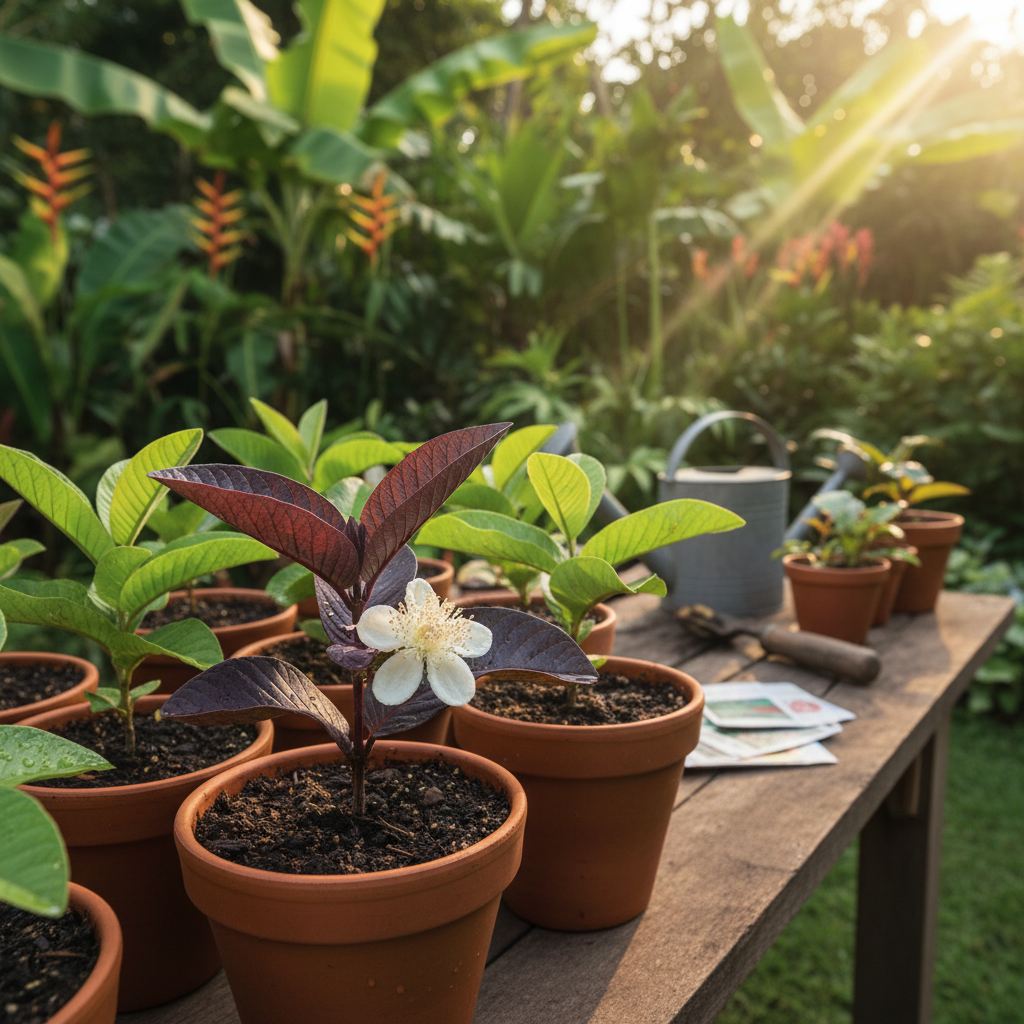
Guava seedlings with purple leaves: care & selection
A home grower recently noticed something many tropical fruit enthusiasts eventually see: six guava seedlings sprouted from one fruit—five with standard green foliage, and one with striking purple leaves that bloomed first. If you’re seeing guava seedlings with purple leaves, you might be wondering whether this is a problem, a prized trait, or a sign you’ve found a standout plant.
For growers building a backyard orchard or container collection, these differences matter. Seed-grown guava can vary widely in vigor, fruit quality, and cold tolerance. Choosing the right seedling now can save years of trial and error and lead to earlier, better harvests. With late fall here in much of the Northern Hemisphere, it’s also the right time to evaluate seedlings and plan winter protection.
In this guide, you’ll learn why some guava seedlings turn purple, how to tell genetic traits from stress responses, how to encourage earlier flowering, and how to select and propagate your best performer. You’ll finish with a simple, step-by-step plan to take your guava from seedling to reliable producer.
Why some guava seedlings turn purple
Genetics vs. stress: the anthocyanin story
Purple coloration in guava foliage is most often caused by anthocyanins—protective pigments that can be either genetically expressed or triggered by environmental stress. Some guava types naturally show a purple flush on new growth, purple-tinged stems, or seasonally deeper hues. When the trait is genetic, new leaves repeatedly emerge with similar coloration and the plant otherwise looks vigorous.When purple leaves are stress-induced, pigment acts like sunscreen or antifreeze, helping leaves cope with high light, cold, or nutrient issues. In these cases, the color often fades as conditions improve.
Common environmental triggers
- Strong sun after low light (e.g., moving seedlings outdoors quickly)
- Cool nights, especially below about 55°F (13°C)
- Nutrient imbalance—classically low available phosphorus can deepen purple tones
- Water stress (too wet or too dry), compacted media, or root restriction
How to tell what you’re seeing
- Consistency: Genetic purple shows up cycle after cycle on new flushes. Stress purple comes and goes.
- Plant posture: Genetic expression comes with normal vigor; stress coloration often pairs with slowed growth or leaf curl.
- Pattern: Genetic purple may include stems and petioles; stress purple is often patchy or strongest on oldest or cold-exposed leaves.
Action step: Over two new flushes, record leaf color, stem tint, and growth rate. If the purple trait persists while growth stays strong, you’ve likely got a genetically interesting seedling worth evaluating.
Callout: Purple doesn’t equal “problem.” In guava, a stable purple flush can be a desirable ornamental trait and may correlate with robust sun or cool tolerance.
What early bloom tells you (and what it doesn’t)
Seedling guavas can flower anywhere from 12 months to 4 years from germination. The purple-leafed seedling that bloomed first in our example could be precocious—a valuable trait for impatient growers. However, early flowers don’t guarantee top-tier fruit.
Interpreting precocity
- Pros: Faster feedback loop for selection; you can taste fruit sooner and decide whether to keep, graft, or cull.
- Unknowns: Fruit size, seediness, sweetness (Brix), aroma, and disease resistance still need evaluation across seasons.
- Caution: Young plants sometimes drop early fruits; don’t judge based on the first couple of harvests alone.
Encouraging flowering without compromising plant health
- Light: Provide full sun (6–8+ hours). Indoors, use high-output grow lights through winter and keep canopies within 12–18 inches of the fixture.
- Nutrition: Use a balanced fertilizer with modest nitrogen and ample potassium and micronutrients. Overdoing nitrogen delays bloom.
- Pruning: Tip-prune to stimulate lateral branching; guava flowers on new growth from mature wood.
- Container cues: Slight root restriction can encourage bloom, but avoid severe pot binding that stalls growth.
Selecting the best guava seedling from a batch
When you sprout multiple seeds from a single fruit, you’re essentially running a small breeding trial. Treat it like one.
Clear criteria for keepers
- Vigor and architecture: Upright yet well-branched, short internodes, balanced canopy.
- Leaf quality: Consistent color for the type (green or stable purple), glossy surface, no chronic chlorosis or distortion.
- Disease and pest tolerance: Fewer issues with scale, whiteflies, or anthracnose under the same care.
- Phenology: Willingness to flower and hold fruit by year 2–3 in warm conditions.
- Stress tolerance: Minimal leaf burn in full sun; resilience to cool nights.
A simple 12–18 month trial plan
- Label each seedling and log dates for flushes, flowering, and any pest/disease notes.
- Standardize care (same pot size, mix, light, feed schedule) so differences are genetic, not cultural.
- When fruit sets, evaluate: sweetness, acidity, aroma, texture, seed-to-pulp ratio, and any grit.
- Assign a 1–5 rating per trait and keep the top one or two. Consider grafting promising tops onto sturdy rootstocks.
If you find that the purple-leafed seedling flowers first and carries through with excellent fruit, you may have discovered a unique selection worth propagating.
Care guide: light, water, nutrition, and winter protection
With November’s shorter days in the Northern Hemisphere, guava care pivots to light management and cold protection. In the Southern Hemisphere, spring growth is accelerating—adjust watering and feeding accordingly.
Light
- Aim for full sun outdoors; indoors use bright windows plus supplemental lighting.
- Rotate containers weekly to keep the canopy balanced and reduce leaning.
- Avoid sudden transitions from shade to strong sun—step up exposure over 7–10 days.
Water and media
- Use a fast-draining mix: roughly 40–50% high-quality composted bark or coco, 30–40% aeration (perlite/pumice), and 10–20% rich compost.
- Keep evenly moist but never waterlogged. Allow the top inch to dry between waterings.
- Mulch container surfaces with fine bark to moderate moisture and temperature.
Nutrition
- Base feed: Controlled-release fertilizer balanced around N-P-K such as 12-4-8 or 8-3-9 with micronutrients.
- Bloom support: Supplement light applications of potassium and magnesium during active flowering and fruit set.
- pH target: 5.5–7.0. If leaves yellow between veins, check pH before chasing deficiency.
Temperature and cold protection
- Ideal growth: Days 70–90°F (21–32°C), nights 60–70°F (16–21°C).
- Young guavas dislike cold; protect below ~40°F (4°C) and avoid frost. Use frost cloth, warm microclimates, or move containers indoors/garage.
- Overwintering containers: Brightest possible location, steady temperatures, and reduced watering. Expect slower growth.
Pruning and training
- Form an open, well-lit canopy: Select 3–4 primary branches and tip-prune to encourage laterals.
- After each flush, lightly prune to stimulate new flowering wood.
- Remove weak, crossing, or inward-facing shoots.
Pests and diseases to watch
- Common pests: Scale, whiteflies, aphids, mealybugs. Manage early with horticultural soap or oil, applied in the evening.
- Fungal issues: Anthracnose and leaf spot in humid conditions. Improve airflow, avoid wetting foliage late in the day, and prune for light penetration.
Propagating and locking in desirable traits
Once you’ve identified a standout—whether it’s the purple-leafed early bloomer or a green-leafed heavyweight—clone it to preserve its qualities.
Air layering and cuttings
- Air layering: High success on semi-hardwood during warm weather. Wrap a girdled section with moist sphagnum and seal; roots form in 6–10 weeks.
- Cuttings: Take 4–6 inch semi-hardwood cuttings with 2–3 nodes. Use rooting hormone, high humidity, and bottom warmth.
Grafting
- Benefits: Faster fruiting on mature rootstocks, uniformity, potential vigor control.
- Methods: Cleft or veneer graft onto compatible guava rootstock once scion wood is mature but not overly lignified.
Seed saving for future trials
- If you’re breeding, save seeds from your favorite fruits and run annual seedling trials. Remember: seedlings won’t be true-to-type, but selection potential is high.
A quick case study recap
From one fruit, six seedlings emerged: five green and one purple. The purple plant bloomed first—likely a combination of genetic precocity and favorable conditions. Over the next year, document its performance: Does the purple trait persist with strong growth? Are the fruits aromatic, sweet, with a good pulp-to-seed ratio? If yes, clone it and keep backups. If not, topwork the rootstock with a better performer from your batch.
Next steps and simple action plan
- Observe: Track two new flushes to confirm if purple is genetic or stress-driven.
- Standardize: Give all seedlings the same light, media, pot size, and feed.
- Protect: As temperatures drop, move containers to bright, protected spots.
- Encourage bloom: Tip-prune lightly and shift nutrition toward potassium.
- Evaluate fruit: Score sweetness, aroma, texture, seediness across two harvests.
- Propagate: Air-layer or graft your best seedling to lock in traits.
If you’d like a field-tested checklist to guide each step—from labeling seedlings to post-harvest tasting—request our Tropical Fruit Grower’s Starter Kit and we’ll send the printable plan.
Conclusion
Purple foliage on guava can be a beautiful clue rather than a red flag. By distinguishing genetics from stress, standardizing care, and evaluating fruit over time, you can turn a mixed batch of seedlings into a reliable, high-performing plant—and maybe even your own named selection. For anyone spotting guava seedlings with purple leaves, the path forward is clear: observe, protect through winter, encourage bloom, and propagate your winner. Which of your seedlings will become next season’s standout?