As early cold snaps arrive in November, many growers report surprising jaboticaba cold damage even when thermometers never dip below freezing. If you’ve walked outside after a breezy night around 34°F and found bronzed leaves or wilted new growth, you’re not alone. Understanding why this happens—and how to prevent it—can save years of growth on these exquisite tropical fruit trees.
“We saw leaf burn at 34°F after a windy night—how is that possible?”
In this guide, we’ll unpack the science behind cold injury on jaboticaba, clarify the wind chill confusion, compare species for cold tolerance, and give you a proven, layered protection strategy. You’ll also get a practical recovery plan if your trees were already hit. By the end, you’ll know exactly how to prevent jaboticaba cold damage, keep fruiting on schedule, and protect your investment all winter long.
Why Jaboticabas Get Hurt Above Freezing
Jaboticabas (Plinia spp.) are subtropical-to-tropical evergreens with thin leaves and tender flushes that can be injured well before hard freezes. That’s why leaf bronzing, tip burn, and flower drop sometimes appear even when your backyard thermometer reads 34–36°F.
The wind chill confusion
Wind chill is a human comfort index; it doesn’t lower the air temperature. A plant cannot cool below the ambient air temperature simply because of wind. However, wind does increase convective heat loss and desiccation. In an advective event (cold, dry air mass plus wind), leaves lose heat and moisture faster, so tissues can be injured at temperatures that would be safe on a calm, humid night. The result looks worse than the number on your thermometer suggests.
Radiational vs. advective freezes
- Radiational: Clear, calm nights. Heat radiates away; coldest air pools in low spots. Frost forms even if official lows are a few degrees warmer.
- Advective: Windy, dry cold fronts. Less frost, more desiccation and wind burn. Injury can appear at higher temperatures than expected.
Jaboticabas dislike both scenarios: tender flushes are vulnerable in radiational events, while mature leaves can scorch during windy fronts.
Know Your Plinia: Species, Age, and Setting
Not all jaboticabas handle cold equally. Tolerance varies by species, age, and whether the plant is in-ground or in a container.
Relative cold tolerance (approximate, short duration)
- More tolerant (mature trees, brief dips): Plinia coronata, P. trunciflora, P. aureana (white), P. phitrantha
- Moderate: P. jaboticaba (Sabará), red hybrid (precocious but not proven hardiest)
- Less tolerant: Very young seedlings and freshly flushed growth across all species
These are general tendencies, not guarantees. Root health, hydration, and microclimate often matter more than the label on the tag.
Age and establishment
- Seedlings/young trees: Tender tissues and small root volumes make them susceptible to cold and wind desiccation. Damage can occur at 34–36°F.
- Established, well-lignified trees: Brief dips to high 20s are often survivable with cosmetic damage, especially if protected from wind.
Container vs. in-ground
- Containers cool faster and expose roots to cold air. A 25°F night can chill a pot far below the temperature of surrounding in-ground soil.
- In-ground trees benefit from buffered soil temperatures and stored ground heat, especially with deep mulch.
The Layered Protection Plan
Think in layers: site, culture, cover, heat, and water. No single tactic is perfect; the combination wins.
1) Site and cultural practices
- Choose a warm microclimate: South-facing wall, courtyard, or near thermal mass (paved area, rock, water feature).
- Avoid frost pockets: Don’t plant at the bottom of slopes where cold air settles.
- Mulch 3–4 inches deep: Wood chips stabilize soil temps and moisture. Keep mulch a few inches off the trunk.
- Water the day before a cold night: Moist soil holds heat better than dry soil, providing several degrees of protection.
- Ease off late nitrogen: Pushy growth in fall equals tender tissues. Favor balanced nutrition; consider potassium and calcium to strengthen cell walls.
- Time your pruning: Avoid heavy pruning late fall; soft regrowth is cold bait.
2) Covers and structures
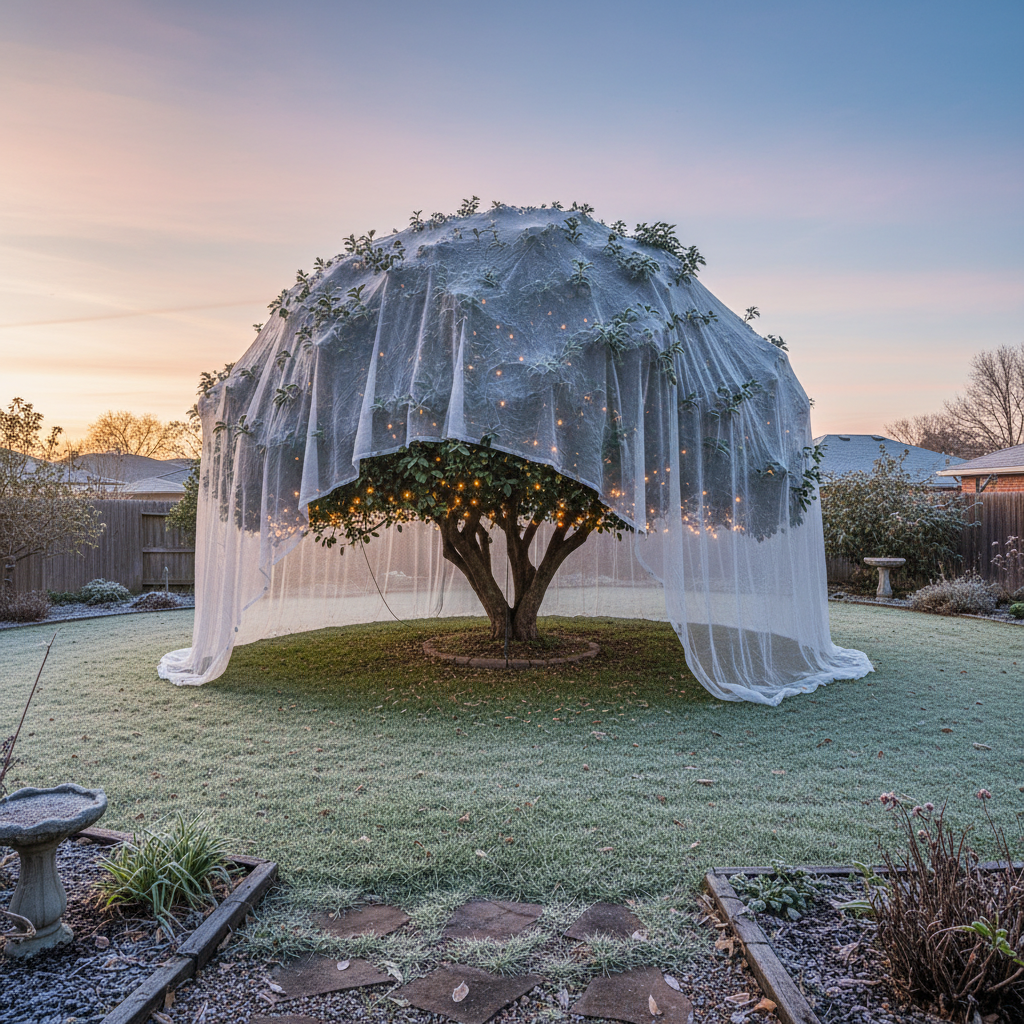
- Frost cloth/row cover (0.9–1.5 oz): Drape to the ground and secure. Keep fabric off leaves with stakes or a simple frame to reduce contact burn.
- Double layer works: A second cloth with a small air gap adds noticeable protection.
- Avoid bare plastic on foliage: If using plastic as a rain and wind shield, place frost cloth between leaves and plastic to prevent condensation burn at sunrise.
3) Gentle heat sources
- C9 incandescent strings under frost cloth: Safe, low-watt heat that adds a few crucial degrees.
- Thermal mass: Black water barrels, large rocks, or filled containers that absorb daytime warmth and release it at night.
- Mini-greenhouse: A pop-up frame or hoop with venting to avoid daytime overheating.
4) Water management during cold events
- Pre-freeze irrigation: Water thoroughly the afternoon before the coldest night.
- Overhead irrigation: Advanced tactic. Running sprinklers throughout a freeze can protect tissue via latent heat, but it must run continuously until temperatures rise above freezing. If you can’t commit, skip this method.
5) Wind shielding on advective nights
- Erect wind breaks on the windward side: Temporary panels, shade cloth, or a movable fence reduce desiccation.
- Anti-transpirants: Mixed results on jaboticaba; use cautiously and test on a small area first.
Diagnosing Damage and Guiding Recovery
Cold injury unfolds in stages. Acting too quickly—especially with pruning—can cause more harm than good.
What damage looks like by temperature range (guideline)
- 36–32°F: Bronze or limp new flush, slight leaf edge burn, flower drop.
- 32–28°F: Widespread leaf scorch, partial defoliation, tender twig dieback.
- 28–25°F: Cambial injury, bark splitting on young trunks, heavy defoliation.
- Below 25°F: Severe wood damage; small trees may die back to the base.
First 72 hours after a cold event
- Do not prune: Tissues may appear dead but recover once temperatures stabilize.
- Shade from rapid thaw: If leaves are icy at sunrise, diffuse the morning sun with a sheet or shade cloth to prevent thaw shock.
- Hydrate the root zone: Water when the soil is above freezing to reduce stress.
2–3 weeks later
- Scratch test: Gently scrape bark; green cambium indicates living tissue. Prune only dead, brown wood back to healthy green.
- Sterilize tools: Clean between cuts to prevent opportunistic infections.
- Light feeding: As new growth appears in spring, offer a balanced, low-salt fertilizer. Avoid heavy nitrogen until the last frost risk passes.
Watch-outs after cold injury
- Sunscald on exposed wood: Whitewash trunks/major limbs with a 1:1 interior latex paint and water mix.
- Fungal cankers on injured bark: Improve airflow and avoid overhead watering late in the day. Only treat if infection is evident.
A Practical Scenario: 34°F With Wind
A potted red hybrid jaboticaba on a patio faces an advective front: 34°F low, steady 15–20 mph wind, very dry air. In the morning, the newest leaves are bronze and curled.
What would have prevented it?
- Move the container against a south-facing wall the afternoon before the front.
- Deeply water the pot and surrounding area.
- Drape double frost cloth to the ground over a simple stake frame.
- Add a string of C9 lights inside the enclosure.
- Place a temporary wind screen on the windward side.
Each step adds a degree or two. Together, they often turn cosmetic injury into no damage at all.
Winter-Ready Checklist for Jaboticaba Growers
- Map your microclimate: Identify frost pockets and wind corridors.
- Stage supplies now: Frost cloth, stakes, clips, C9 lights, extension cords, mulch.
- Set thresholds: Cover at 36°F for young trees, 34°F for established trees if windy/dry.
- Water strategically: Irrigate the afternoon before a cold night.
- Protect new flushes: Cover any tree that has tender growth, even if the forecast is 35–38°F.
- Delay heavy pruning: Save shaping for late winter/early spring after the last major freeze threat.
- Keep records: Note conditions, what you tried, and the results to refine your plan.
Key Takeaways
- Jaboticabas can suffer injury above 32°F, especially with wind and dry air.
- Species, age, container status, and microclimate drive outcomes as much as the exact low temperature.
- Layered protection—site, culture, cover, heat, water—beats any single tactic.
- Be patient when recovering; prune only once damage is clear and the plant begins to push new growth.
If you want a simple plan for your orchard, grab our cold-night checklist, gather your supplies now, and set clear action thresholds. With a few smart steps before and during a front, you can prevent jaboticaba cold damage, protect this season’s crop, and keep your trees thriving into spring. What’s the one protection layer you’ll add before the next cold snap?